At first glance, trekking-pole tents seem like the obvious winner. They eliminate dedicated tent poles, reduce weight, and should cost less. Right?
Well, not necessarily.
There’s one thing that’s often missing from the comparison: the trekking poles themselves.
We decided to compare two popular ultralight tent setups against their freestanding alternatives, including the weight and cost of the poles needed to pitch them.
The results might surprise you.
1. Gossamer Gear: The One vs. The Free
The One – One Person Trekking-pole tent
The Free – One Person Freestanding tent
The One weighs just 19.68 oz compared to 29.8 oz for The Free. That’s a pretty significant difference on paper.
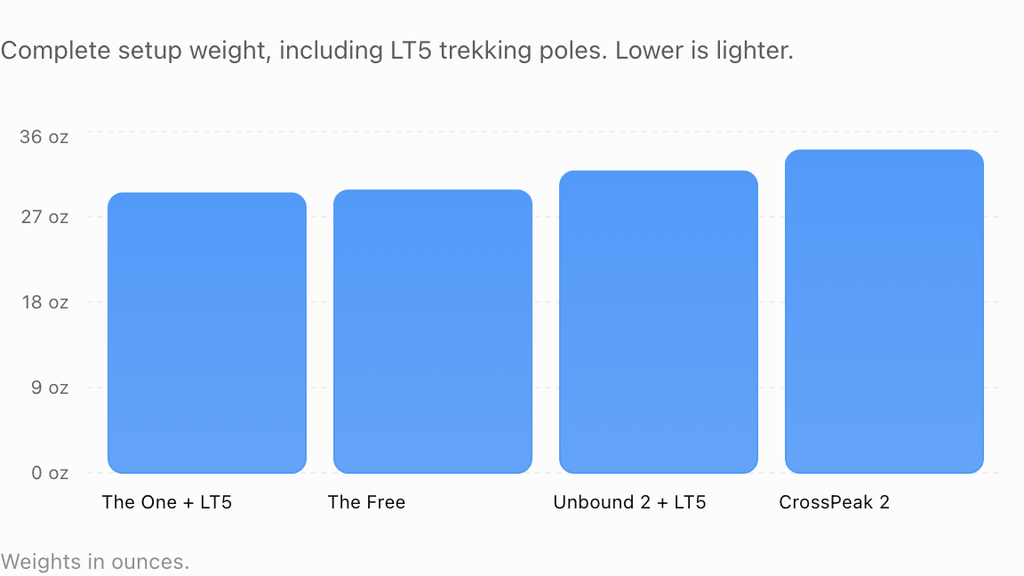
But add 9.8 oz for the LT5 trekking poles, and the numbers look very different.
| The One + LT5 | The Free | |
|---|---|---|
| Tent | 19.68 oz | 29.8 oz |
| Support poles | 9.8 oz | Included |
| Total weight | 29.48 oz | 29.8 oz |
| Tent price | $315 | $400 |
| Trekking poles | $195 | Included |
| Total cost | $510 | $400 |
0.32 oz Weight advantageThe One + LT5
$110 Additional cost The One + LT5
That’s right. The complete trekking-pole setup is only 0.32 ounces lighter, while costing $110 more.
2. Hyperlite Mountain Gear: Unbound 2 vs. CrossPeak 2
Unbound 2 – Two person trekking-pole tent
CrossPeak 2 – Two person freestanding tent
The same thing happens with Hyperlite Mountain Gear.
The Unbound 2 weighs 22 oz, while the CrossPeak 2 weighs 34 oz. But after adding the 9.8 oz LT5 poles, the Unbound 2 setup weighs 31.8 oz.
That’s only 2.2 oz lighter.
| Unbound 2 + LT5 | CrossPeak 2 | |
|---|---|---|
| Tent | 22 oz | 34 oz |
| Support poles | 9.8 oz | Included |
| Total weight | 31.8 oz | 34 oz |
| Tent price | $795 | $950 |
| Trekking poles | $195 | Included |
| Total cost | $990 | $950 |
2.2 oz – Weight advantage Unbound 2 + LT5
$40 – Additional cost Unbound 2 + LT5
Again, the difference isn’t nearly as dramatic as the tent-only specifications suggest.
3. Let’s Look at the Big Picture:
Total shelter cost:
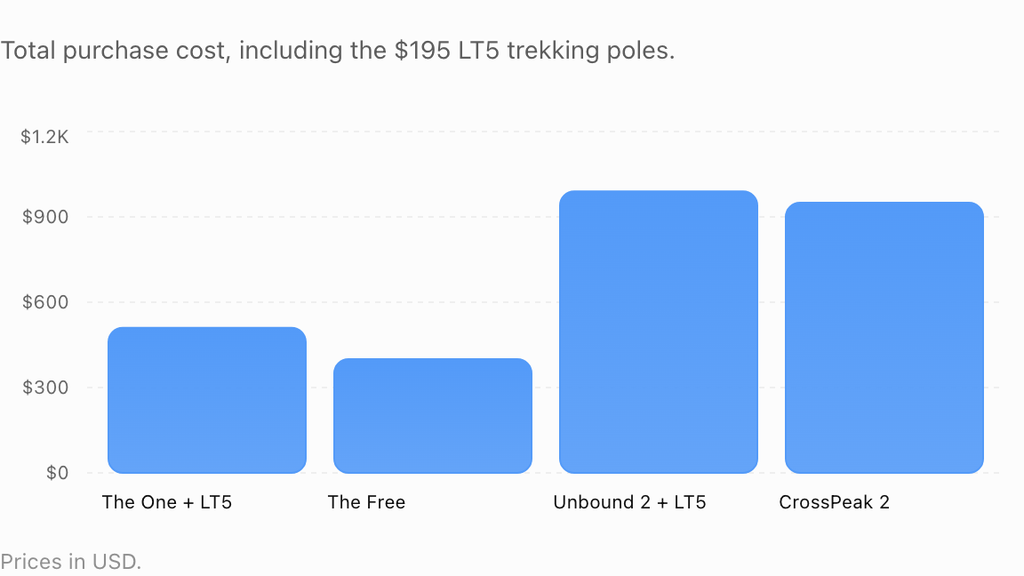
The takeaway? In both comparisons, the trekking-pole setups are only marginally lighter, and they’re actually more expensive.
4. What About Worn Weight?
There’s one important argument worth considering.
Trekking poles are often classified as worn weight rather than pack weight. Since you’re carrying them in your hands while hiking, they aren’t necessarily part of the weight on your back.
And that’s a perfectly reasonable way to look at it.
If you already hike with trekking poles, using them to support your tent is an excellent way to get more out of equipment you’re already carrying.
But if you’re buying trekking poles specifically to pitch your tent, their weight and cost deserve to be part of the equation.
There’s a difference between comparing tent weights and comparing complete shelter systems.
Neither calculation is wrong. Just make sure you’re comparing apples to apples.
5. So Which Should You Choose?
We’re not arguing that freestanding tents are better. Far from it. Both styles have a lot going for them.
Trekking-pole tents are fantastic for backpackers who already use trekking poles. They eliminate dedicated tent poles and make excellent use of equipment you’re already carrying.
Freestanding tents offer convenience, flexibility when choosing a campsite, and don’t require trekking poles to pitch.
The biggest takeaway is simple:
Don’t compare the weight of a tent to the weight of another tent. Compare the weight of the complete shelter system.
Trekking-pole tents aren’t automatically lighter or cheaper. Sometimes the difference is surprisingly small.
Both styles are excellent. Choose the one that works best for the way you backpack, rather than choosing based on advertised tent weight alone.
RIKKAR | ULTRALIGHT DONE RIGHT